Things to Do in Nuremberg
Sausage smoke, fortress walls, and a city that chose to remember
Top Things to Do in Nuremberg
Find activities and tours you'll actually want to do. Book through our partners -- no booking fees.


Plan Your Trip
Essential guides for timing and budgeting
Climate Guide
Best times to visit based on weather and events
View guide →Day Trips
The best excursions and nearby destinations worth the journey
Explore day trips →Where to Stay
Best neighbourhoods, hotel picks, and booking tips
Find hotels →Travel Insurance
What's required, what coverage matters, and how to get a quote
Read guide →What to Pack
Climate-specific gear, essentials, and what to leave at home
See packing list →When Should You Visit Nuremberg?
Tap a month for weather, crowds, and highlights
View full year-round climate guide →Road Trips from Nuremberg
Explore scenic driving routes and epic journeys
Explore Nuremberg
Christkindlesmarkt
Landmark
Documentation Centre Nazi Party Rally Grounds
Landmark
Germanisches Nationalmuseum
Landmark

Hauptmarkt And Schoner Brunnen
Landmark
Nuremberg Castle Kaiserburg
Landmark
Altstadt
District
Gostenhof
District
St Lorenz
District
Sudstadt
District
Wohrd
District
Your Guide to Nuremberg
About Nuremberg
Nuremberg announces itself by smell. Step through the sandstone gateway into the Altstadt and charcoal smoke hits first. It drifts from bratwurst grills lining the Hauptmarkt, sharp with marjoram and beechwood, hanging over the medieval square like weather. The Nürnberger Rostbratwurst is barely the length of your little finger.
Grilled over open flame, served six at a time on a tin plate with horseradish and a bread roll that exists mostly to hold. Above the market, the Kaiserburg sits on its sandstone ridge the way it has for nine hundred years. What you are looking at is one of Europe's most painstaking reconstructions. Wartime bombing flattened the Altstadt almost entirely.
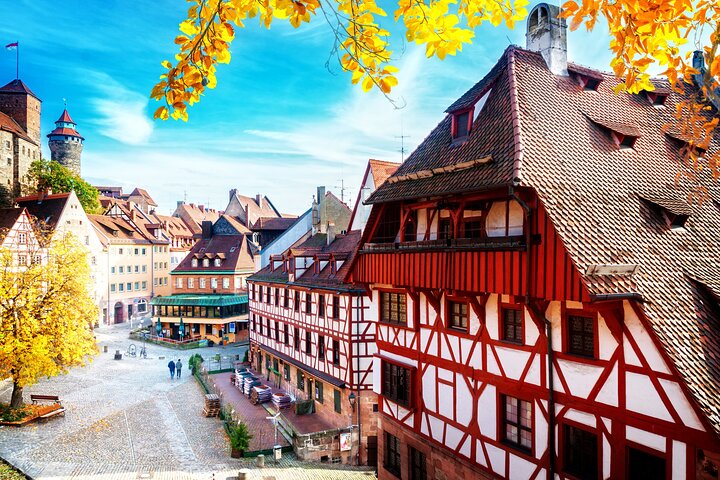
The city chose to rebuild it stone by stone from architectural photographs rather than start over in concrete. That decision tells you everything about Nuremberg. The same impulse that reconstructed the half-timbered houses along Weißgerbergasse, the old tanners' lane curving along the Pegnitz River where the plaster glows the color of pale honey in afternoon light, also preserved the massive Nazi Party Rally Grounds at Dutzendteich and turned the Palace of Justice into the Memorium Nuremberg Trials.
The weight of that history can catch you between bites of Lebkuchen from a bakery near Obstmarkt. The gingerbread is still warm, spiced with clove and cardamom, coated in dark chocolate that cracks when you break it. Nuremberg does not ask you to pick a single mood. Cross into Gostenhof, the scruffier neighborhood west of the city walls where street art covers more surface area than plaster.
You find a city that carries fortress and courtroom, Christmas market and documentation center, all of it at once, without looking away.
Travel Tips
Transportation: Nuremberg's Altstadt is compact enough that your feet handle most of it. Trying to drive through the pedestrianized center is not worth the headache. The VGN transit network runs three U-Bahn lines, tram routes, and buses that reach the outer neighborhoods reliably. A day pass pays for itself after two or three rides. It works on all modes, so pick one up from the ticket machines at any U-Bahn station when you arrive. The U2 runs directly from Nuremberg Airport to the Hauptbahnhof in about twelve minutes. The taxi line outside arrivals is an exercise in overpaying. One thing to know: validate your ticket before boarding. Plainclothes inspectors patrol the trains. They have heard every tourist excuse and are unmoved by all of them.
Money: Germany runs on euros. Nuremberg is more cash-dependent than you might expect from western Europe. The bratwurst stands on the Hauptmarkt, the Lebkuchen shops near Obstmarkt, most Altstadt bakeries, and the beer cellars along the Pegnitz still prefer cash. This is gradually shifting. Larger restaurants and hotels handle contactless payments without fuss. Stick to bank-branded ATMs. Skip the independent machines that cluster near tourist areas, as the fees on those add up fast. Tipping is simple: round up or add roughly ten percent. Hand it directly to the server when you pay rather than leaving it on the table. That detail matters here.
Cultural Respect: Sunday in Nuremberg means closed shops, quiet streets, and no groceries unless you planned ahead on Saturday. The Ladenschlussgesetz is not a suggestion. Ruhezeit, the mandated quiet hours after ten at night, is taken seriously. Neighbors will knock on your door rather than suffer through it. At the Documentation Center and the Memorium Nuremberg Trials, the mood is reflective and sober. Raised voices and grinning selfies mark you in ways nobody will mention politely. Beer gardens, by contrast, are where the formality drops. Sharing a long wooden bench with strangers is expected, not awkward. A nod or raised glass to your table neighbors opens things up faster than any introduction.
Food Safety: Food safety is a non-issue here. Germany's hygiene standards are exacting. The real priority is understanding Franconian cooking, which diverges from the Bavarian stereotype sharply. Nürnberger Rostbratwurst is EU-protected, finger-length, seasoned with marjoram, and grilled over beechwood until the casing crackles. Order a Drei im Weggla, three tucked into a round roll with mustard, from any Altstadt vendor for one of the best quick meals in Germany. Schäufele, a slow-roasted pork shoulder with skin that shatters like glass over a mound of potato dumplings, is what locals eat. For beer, find a cellar bar in the Altstadt pouring Rotbier, Nuremberg's malty, faintly smoky red ale brewed here since the Middle Ages.
When to Visit
Nuremberg's climate is continental and honest about it. Summers are warm and occasionally hot, winters are cold and grey, and the city does not pretend otherwise. June through August brings daytime temperatures between 20 and 27°C (68 to 81°F), long evenings that stay light past nine, and open-air concerts in the Kaiserburg courtyard.
The Bardentreffen music festival in late July fills the Altstadt with free stages on every corner. Rock im Park draws tens of thousands to the park at Dutzendteich in early June. Hotel rates climb to their summer peak. Altstadt foot traffic thickens noticeably. Nuremberg never reaches the sardine-tin density of Munich or Prague.
Most international tourists skip it for its louder Bavarian neighbor. That works entirely in your favor. September and October are likely the best months if crowds bother you at all. Temperatures settle into a comfortable 12 to 18°C (54 to 64°F) range. The Franconian vineyards east of the city turn copper and gold. Accommodation prices drop meaningfully from the summer highs.
The autumn Volksfest, Nuremberg's answer to Oktoberfest, runs for two weeks in late August into September with considerably less chaos and better sausages. October starts crisp and finishes cold. Early darkness shortens your sightseeing window. Beer cellars feel warmest when the weather outside is not. November through February is winter in the real sense.
Temperatures hover between minus 3 and 4°C (27 to 39°F). The Pegnitz occasionally freezes at its edges. The sky settles into an unbroken grey that can last weeks. None of that matters in December. The Christkindlesmarkt transforms the Hauptmarkt into the most famous Christmas market in Germany, running from late November through Christmas Eve.
The smell of Glühwein, roasted almonds, and Lebkuchen in freezing air is as close to a postcard as real life gets. Accommodation books out weeks in advance for December. Prices reflect it. January and February are the true low season. The city belongs to its residents. The Kaiserburg grounds stand nearly empty against the snow.
March through May is the slow thaw. April temperatures range from 7 to 15°C (45 to 59°F). The Blaue Nacht arts festival in May lights the Altstadt's sandstone facades with blue projections that turn the old town into something from another century entirely. Hotel prices sit at their lowest outside deep winter. The catch: Nuremberg's spring is unpredictable.
You will likely see four seasons in a single afternoon. Pack layers. Keep the umbrella within reach.
More Ways to Experience Nuremberg
Tours, day trips, and local experiences curated by on-the-ground operators.
Didn't see anything interesting yet?
Browse Viator's full catalog of tours, day trips, food experiences, and private guides in Nuremberg.
See All Nuremberg Tours on Viator